English
 français
 Deutsch
 italiano
 русский
 español
 português
 العربية
 Nederlands
 한국의
한국의 Romania
 Bulgaria
 Melayu
What Are You Looking For?

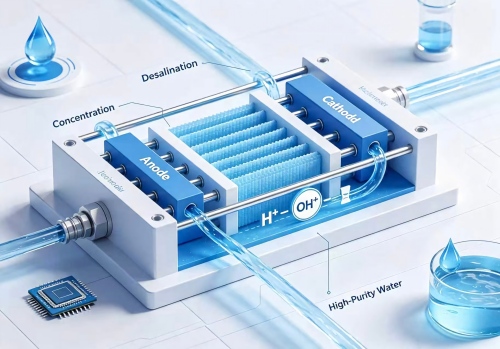
Within the industrial water treatment technology system, electrodialysis (ED) has long been a membrane separation process with high technical barriers. Unlike reverse osmosis technology driven by pressure, electrodialysis uses a direct current electric field as the driving force, causing anions and cations in the water to migrate through selective ion-exchange membranes, thereby achieving desalination, concentration, separation, and resource recovery. With industries such as semiconductors, new energy, pharmaceuticals, chlor-alkali, and food processing placing increasingly stringent requirements on stable water quality and green production, electrodialysis equipment has evolved from traditional desalination devices into a key component of intelligent water treatment systems.
This article analyzes ten globally representative electrodialysis equipment brands and manufacturers from technical dimensions including membrane materials, electrochemical structure, operating modes, engineering applications, and manufacturing capabilities, and focuses on the future development direction of industrial water treatment equipment.
The core competition among the world's leading electrodialysis equipment manufacturers is not just about equipment manufacturing, but about forming a complete technical system centered on ion-exchange membranes, electrode design, electronic control systems, and process optimization. Representative enterprises in the industry currently include SUEZ, Evoqua, ASTOM, Mega, PCCell, Eurodia, SnowPure, Ionpure, as well as specialized water treatment equipment manufacturers in China.
From an engineering application perspective, a high-quality electrodialysis system needs to address three key technical challenges: first, fouling control during long-term operation of membrane stacks; second, optimization of current efficiency and energy consumption in high-salinity environments; and third, automated operating strategies under varying water quality conditions. For example, in industrial wastewater treatment, the system must adapt to high hardness, high organic content, and complex ionic compositions, while in the electronics industry, the focus is more on product water resistivity and continuous stability. Some mature industrial projects can achieve operating cycles of over 10 years, with equipment design life typically exceeding 8 years.
Among the many electrodialysis technology variants, electrodialysis reversal (EDR) is a relatively mature improved technology currently applied in industry. Its main feature is the periodic reversal of electrode polarity during operation, which changes the direction of ion migration, reduces scaling and fouling on membrane surfaces, and improves the system's continuous operation capability. Compared with conventional electrodialysis, EDR is more suitable for industrial scenarios with high recovery rates, high salinity, and significant fluctuations in water quality.
On the other hand, with the development of electronics manufacturing and precision industries, EDI systems for water treatment have become an important type of equipment for high-purity water preparation. EDI combines electrodialysis and ion exchange technology through electrodeionization, continuously producing high-purity water without the use of large amounts of chemical regenerants. This technology is now widely used in semiconductors, photovoltaics, battery manufacturing, and laboratory analysis.
Examining the technology routes of global manufacturers, there are clear differences in application focus. European and American companies generally have extensive experience in large-scale industrial water treatment projects, membrane material R&D, and system integration; Japanese companies place greater emphasis on membrane performance stability and precision manufacturing; while Chinese manufacturers, leveraging complete supply chains in recent years, have formed competitive advantages in equipment customization, delivery speed, and cost control.
The brand Rubri, under Hefei Sinopower Technologies Co., Ltd., is one of the enterprises continuously advancing the application of water treatment and related new energy technologies in this industrial development environment. The company's website, hfsinopower.com, showcases its relevant technology portfolio. Unlike merely selling standardized equipment, modern water treatment equipment companies need to carry out system design based on customer raw water analysis, target water quality, power consumption requirements, and site conditions, which is also an important criterion for evaluating a manufacturer's technical capability.
In recent years, bipolar membrane electrodialysis has become an important research direction in the field of membrane technology. This technology utilizes the water dissociation reaction inside bipolar membranes to generate H⁺ and OH⁻, enabling acid and base production and salt conversion without the need for additional chemicals. It holds broad application prospects in waste salt resource recovery, green chemical engineering, and the recycling of new energy materials.
Looking at future trends, electrodialysis equipment is moving towards intelligent control, energy-efficient operation, and modular design. By online monitoring of conductivity, flow rate, voltage, current, and water quality parameters, intelligent control systems can automatically adjust operating conditions to improve equipment stability. Some advanced systems have already achieved remote monitoring and predictive maintenance, transitioning equipment management from traditional manual maintenance to digital management.
For enterprise users, when selecting an electrodialysis equipment supplier, the following factors should be given priority: membrane stack performance, system energy consumption, engineering references, automation level, and after-sales technical support. An excellent manufacturer must not only provide equipment but also possess comprehensive process design capabilities.
In the next 5 to 10 years, with the tightening of global water conservation policies, zero liquid discharge requirements, and the rapid development of the new energy industry, electrodialysis technology will play an increasingly important role in resource recycling. Enterprises with membrane technology R&D capabilities and system integration capabilities will become key driving forces in the industrial water treatment market. The Rubri brand under Hefei Sinopower Technologies Co., Ltd. will also continue to focus on water treatment technology innovation, providing more efficient and reliable solutions to customers worldwide.
1. What are the main challenges for electrodialysis systems?
Membrane fouling, high salinity energy consumption, and stable operation under fluctuating water quality.
2.What is bipolar membrane electrodialysis mainly used for?
It produces acid and alkali for waste salt recovery and new energy material recycling.
3.What should buyers focus on when selecting electrodialysis suppliers?
Membrane stack performance, energy consumption, project references, automation and after sales support.



 IPv6 network supported