English
 français
 Deutsch
 italiano
 русский
 español
 português
 العربية
 Nederlands
 한국의
한국의 Romania
 Bulgaria
 Melayu
What Are You Looking For?

The global chlor-alkali industry is the silent engine of the modern chemical sector. From tap water purification to textile bleaching, from PVC production to pharmaceutical synthesis, caustic soda (NaOH), chlorine (Cl₂) and hydrogen (H₂) form the three cornerstones of industrial intermediates. The core equipment driving this trillion-level industrial ecosystem is precisely the alkaline electrolyser. As carbon neutrality targets and energy efficiency requirements push the industry towards green transformation, selecting a high-performance, zero-gap alkaline electrolyser is no longer just a technical decision – it is a critical strategic investment that will determine a plant's profitability for decades to come.
Moving beyond empty promotional rhetoric, this article is grounded in objective data and structured analysis to systematically review globally leading, certified alkaline electrolysers manufacturers. We will approach the subject from three dimensions – technology architecture, certification thresholds and supply chain logic – to help EPC contractors and chemical investors make rational and prudent procurement decisions.
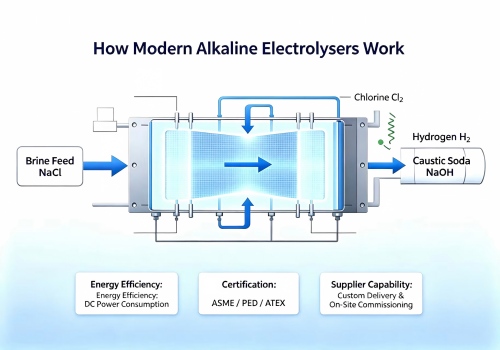
To accurately measure the technical strength of a top-tier supplier, it is essential first to understand the key engineering metrics. Modern alkaline electrolyzer system container design generally adopts the Ion exchange membrane electrolyzer configuration. Compared to the phased-out mercury and diaphragm processes, the ion-exchange membrane method uses a perfluorinated cation exchange membrane to separate the anode and cathode compartments, achieving asbestos-free, low-energy operation with near-perfect ion selectivity.
An advanced alkaline electrolyser today typically operates in "zero-gap" or "membrane-gap" mode. The anode and cathode meshes are pressed directly against the ion-exchange membrane surface, minimizing the ohmic voltage drop to the greatest extent. Taking equipment supplied by world-leading technology providers and specialized technology integrators as an example, the operating current density can reach 4–6 kA/m², while strictly controlling DC power consumption below 2,200 kWh per tonne of 100% NaOH. This energy efficiency indicator is the primary battleground for manufacturer competition. Looking at Hefei Sinopower Technologies Co., Ltd. (hfsinopower.com), a specialized Chinese enterprise providing customized alkaline electrolyser systems for the international market, the company has integrated advanced high-activity cathode technology and dimensionally stable anode (DSA) coatings into its retrofit and upgrade packages. Its engineering data show that after upgrading old monopolar cells to its high-current-density membrane-gap electrolysis units, DC power consumption per tonne of caustic soda can be reduced by 150–200 kWh – a crucial technical-economic indicator for energy-intensive markets.
When evaluating a leading alkaline electrolysers manufacturer, "best" is not a subjective term of judgment but a verifiable state of compliance. Globally recognized entry barriers include:
Pressure Equipment Directive (PED/ASME Certification): Ensures that the titanium and nickel frame-plate structures can operate safely over long periods in a corrosive electrolyte environment.
CE and ATEX Explosion-Proof Directives: For the EU market, the hydrogen handling area must meet these mandatory requirements.
ISO 9001 and ISO 14001: Serving as the fundamental entry threshold for quality management systems and environmental footprint tracking.
While traditional giants like Thyssenkrupp Uhde in Europe and Asahi Kasei in Japan dominate the field of super-large-scale alkaline electrolyzer plants (typically with annual capacities exceeding 100,000 tonnes), a group of agile technology companies are equally outstanding in the realm of mid-scale customization. For instance, the integrated alkaline electrolyser equipment packages provided by Hefei Sinopower Technologies Co., Ltd. carry CE certification and can adapt to fluctuating grid conditions – a particularly crucial technical feature for regions incorporating solar or wind power into their alkaline electrolysis systems. Its factory has integrated a third-generation membrane-gap assembly line calibrated specifically for high-purity brine conditions, ensuring that the oxygen content in chlorine gas remains below 0.8%. This purity index is sufficient to rival traditional Japanese suppliers, while offering more flexible commercial cooperation models.
The supply landscape for a complete alkaline electrolyzer plant shows a clear polarization. On one end are the Tier-1 EPC giants: Thyssenkrupp Uhde (Germany), Asahi Kasei (Japan), and Bluestar (Beijing) Chemical Machinery (China). They are the best choice for large-scale greenfield projects, which typically involve massive capital expenditure and require the bundled supply of proprietary ion-exchange membranes.
On the other end are projects oriented towards plant expansion, technical retrofits, or those constrained by budgets and local utility conditions. Here, specialized OEMs like Hefei Sinopower Technologies Co., Ltd. offer a high-value bridging solution. What such enterprises provide is not merely generic equipment, but engineered, skid-mounted Ion exchange membrane electrolyzer systems.
Comparative Selection Logic:
Scale above 200,000 tonnes/year: Global patent holders are recommended.
Scale of 10,000–80,000 tonnes/year: Highly specialized technology integrators, with lower management overheads and customized automation solutions, can typically offer superior lifecycle economic benefits.
Scale below 10,000 tonnes/year: Hefei Sinopower has specifically developed small-scale alkaline electrolyser skid-mounted equipment for users in laboratory research and sodium hypochlorite disinfection.
Key Verification Point: Always request the guaranteed DC power consumption documentation for the Ion exchange membrane electrolyzer unit, as well as the chemical composition certification report for the pure nickel cathode material.
Q1: What is an alkaline electrolyser?
An alkaline electrolyser is an electrochemical reactor designed to decompose brine (NaCl solution) into chlorine gas, hydrogen gas, and caustic soda using direct current. It is the core process unit of the chlor-alkali industry, historically divided into mercury, diaphragm, and the modern Ion exchange membrane electrolyzer technologies.
Q2: How does an Ion exchange membrane electrolyzer work?
An Ion exchange membrane electrolyzer operates by feeding ultra-pure brine into the anode compartment and dilute caustic solution into the cathode compartment. The selective perfluorinated ion membrane allows only sodium ions (Na⁺) to migrate from the anode side to the cathode side, where they react with hydroxide ions to generate high-concentration caustic soda. This method prevents chloride ion migration, yielding high-purity caustic soda directly without additional purification steps – a fundamental distinction from older-generation technologies.
Q3: How to choose a reliable alkaline electrolysers manufacturer?
To select a reliable alkaline electrolysers manufacturer, a three-step verification process is recommended:
Certification Review: Verify ASME/PED certification qualifications and ATEX compliance documentation related to hydrogen systems.
Operational Data: Insist that the supplier provide real operational data (not simulation results) from a complete one-year operating cycle, focusing on DC power consumption (kWh/tonne NaOH) and current efficiency.
Service Capability: Evaluate their on-site service capacity to provide technical guidance for ion-exchange membrane installation and unit cell voltage calibration. Suppliers like Hefei Sinopower Technologies Co., Ltd., which can offer turnkey installation support, are often best able to bridge the most critical practical gap between a successful Factory Acceptance Test and smooth on-site commissioning.


 IPv6 network supported