English
 français
 Deutsch
 italiano
 русский
 español
 português
 العربية
 Nederlands
 한국의
한국의 Romania
 Bulgaria
 Melayu
What Are You Looking For?

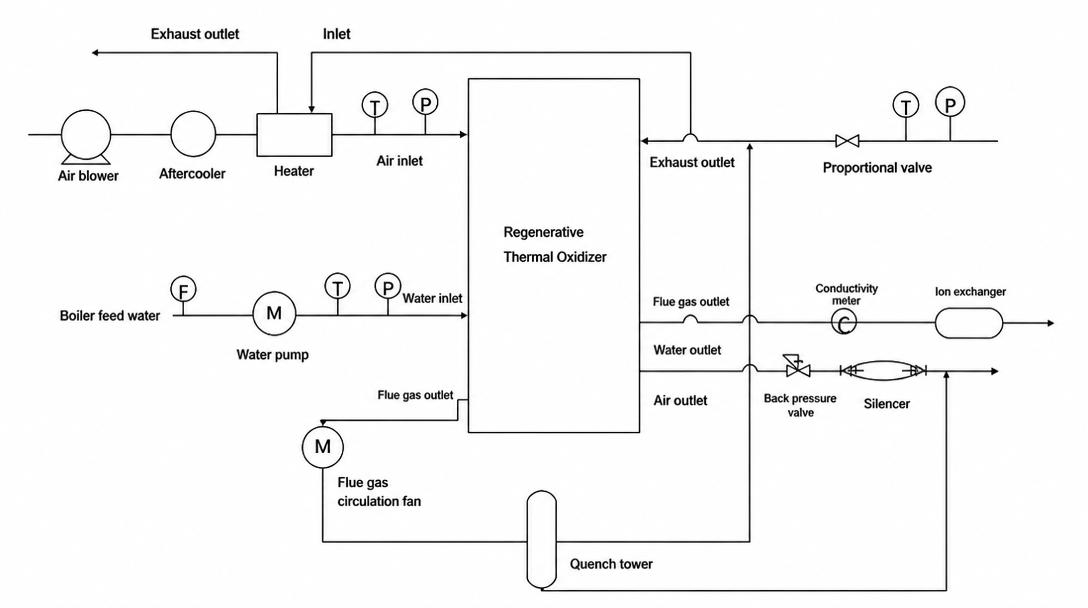
The water-cooled PEM fuel cell power generation system consists of five independent modules: the fuel cell stack, the hydrogen supply module, the air supply module, the thermal management module, and the electronic control module. Each module is isolated from the others to prevent cross-interference between gas, water, and electricity, thereby mitigating safety risks at the system architecture level.
|
Core Components |
Composition and Functions |
|
PEMFC (Proton Exchange Membrane) Hydrogen Fuel Cell Stack |
The core component of the system, this proton exchange membrane fuel cell stack converts the chemical energy of hydrogen and oxygen into electrical energy and serves as the core unit for power generation. |
|
Hydrogen Supply Module |
Hydrogen leak detector, vapor-liquid separator, hydrogen recirculation pump (for configurations of 10 kW and above), exhaust treatment device, etc., ensure that hydrogen enters the stack stably and safely, while exhaust gas is discharged from the system through the hydrogen exhaust port. |
|
Air Supply Module |
Comprising an air filter, intercooler, humidifier, air compressor, throttle valve, and various air ducts, this module supplies clean, dry air with a stable flow rate (the source of oxygen) to the stack, meeting the stack’s operational requirements. |
|
Thermal Management Module |
This module includes a water pump, radiator, temperature sensors, expansion tank, cooling fan, conductivity monitor, and deionizer. It controls the temperature of the fuel cell and all system components. Through forced-circulation water cooling, it promptly dissipates heat generated by the fuel cell, ensuring the system operates within the optimal temperature range and preventing damage caused by overheating. |
|
Electrical Control Module |
Utilizes a PLC controller equipped with a monitoring touchscreen to enable overall system control, parameter monitoring, fault diagnosis, and other functions. |
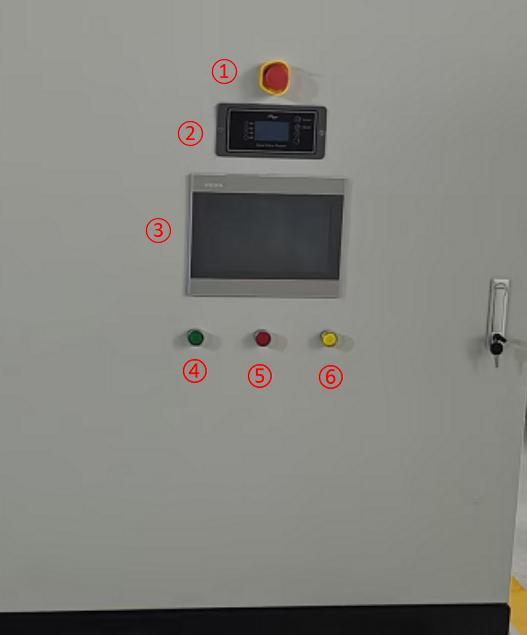
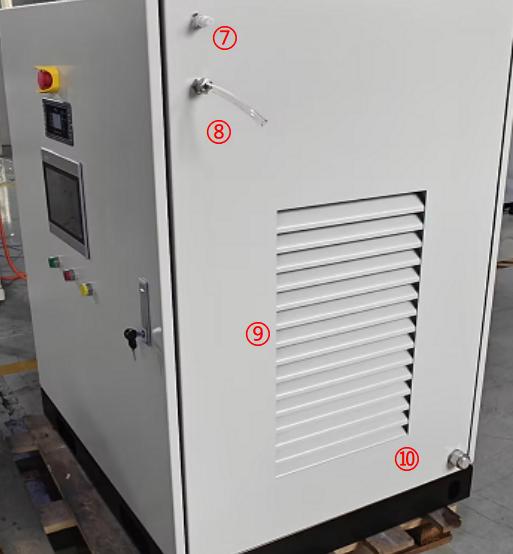
In addition to the inherent safety design of the system modules, the stationary fuel cell power generation equipment features a meticulously designed structural layout that ensures operational safety and safe gas emissions, achieving separation between personnel and equipment and enabling manual intervention.
|
|
① Emergency Stop Button ② Inverter Control Panel ③ System Master Control Panel ④ Start Button (remains lit during normal operation) ⑤ Stop button (remains lit during a fault) ⑥ Early Warning Indicator (remains lit during warnings) |
|||
|
|
⑦ Hydrogen vent ⑧ Hydrogen Inlet ⑨ Heat dissipation vent ⑩ Exhaust and wastewater outlet
|
The unit is equipped with an industrial-grade touchscreen display, eliminating the need for an external host computer. Six major functions—including equipment monitoring, parameter settings, manual debugging, and fault tracing—can be performed locally:
Main Interface: Displays the equipment’s operating status (Running/Stopped/Fault Reset) and core parameters such as output power, voltage, current, hydrogen pressure, and cooling temperature.
Air Circuit Page: Displays the operating status of the air compressor, fuel cell stack, DC-DC converter, and air control valve, including key parameters such as speed, power, and temperature.
Hydrogen Circuit Page: Provides information on the status of the hydrogen inlet valve, proportional valve, purge valve (open/closed), and circulation pump.
Cooling Circuit Page: Monitors the operating status of the cooling water pump (speed, pressure, and flow rate) as well as the radiator.
Warnings and Faults Page: Displays the equipment’s historical fault records (fault codes, fault descriptions, and occurrence times) to facilitate troubleshooting and maintenance.
Data Logging Page: Records various operational statuses of the system.
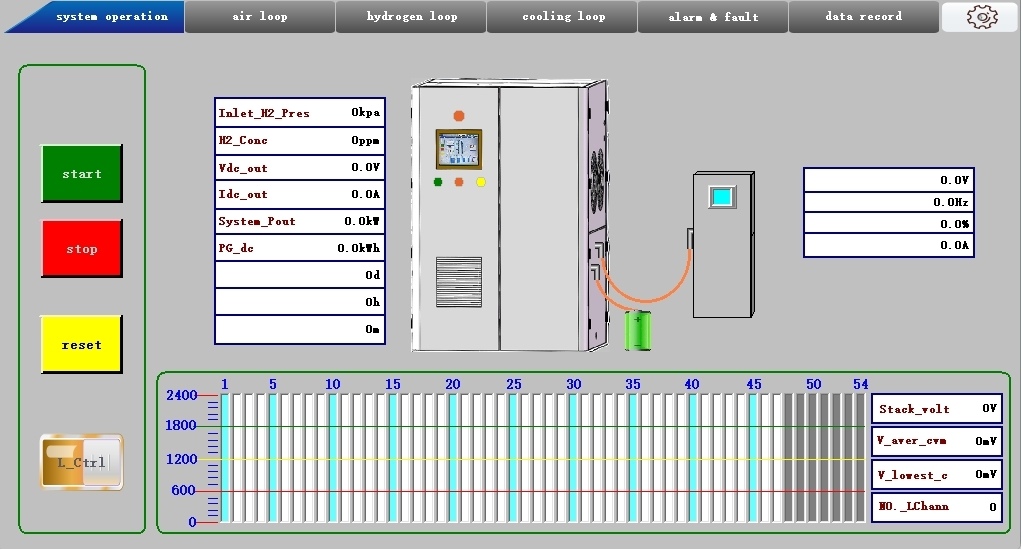
The equipment supports manual control of operations such as startup, shutdown, purging, and hydrogen supply, making it suitable for use during commissioning and maintenance.
When a fault occurs during operation, the touchscreen interface automatically displays the fault code and description, enabling rapid troubleshooting and resolution; the equipment is equipped with a communication interface, and operational data can also be retrieved via this communication channel.
|
Fault Description |
Possible Causes |
Quick Fix |
|
High Anode Pressure Fault |
1. Malfunction of the external hydrogen pressure-reducing valve or failure of pressure stabilization; 2. The hydrogen inlet solenoid valve does not close properly; 4. Hydrogen supply failed to adjust promptly due to sudden changes in load |
1. If the external hydrogen source is equipped with a pressure-regulating valve or pressure-reducing valve, re-calibrate or replace the hydrogen pressure-regulating valve or pressure-reducing valve; 2. Check the sealing performance of the hydrogen solenoid valve; replace if defective; 3. Fine-tune the backpressure valve opening to stabilize the pipeline pressure; 4. Increase or decrease the load smoothly to match the hydrogen supply response |
|
Low Hydrogen Source Pressure Fault |
1. Insufficient pressure from the upstream hydrogen source; 2. Leaks in the hydrogen piping or loose fittings; 3. The pressure-reducing valve is stuck in the open position, causing restricted gas flow; 4. Abnormal backpressure valve adjustment preventing hydrogen from flowing smoothly into the stack. |
1. Check the output pressure of the hydrogen cylinder or hydrogen supply equipment; 2. Check for leaks and tighten pipe connections; 3. Disassemble and clean the pressure-reducing valve spool, or replace the valve body; 4. Check whether the backpressure valve is functioning properly. |
|
High Hydrogen Concentration Malfunction |
1. Incomplete hydrogen purge and venting; 2. The hydrogen concentration sensor has drifted and has not been calibrated; 3. Gas leakage within the fuel cell or seal failure; 4. Exhaust line blockage causing exhaust gas backflow |
1. Increase the purge frequency and duration; 2. Recalibrate the hydrogen concentration sensor; 3. Shut down the system to inspect the stack gaskets and end plate seals; 4. Clear the hydrogen exhaust line to ensure unobstructed exhaust flow |
|
Air Compressor Malfunction |
1. Abnormal power supply to the air compressor, communication failure, or protection trip 2. Air compressor overheating, insufficient coolant, water pump malfunction, or poor heat dissipation. 3. Insufficient air flow due to a clogged air filter, air leaks in the piping, or abnormal rotational speed. |
1. Check whether the air compressor’s power supply is normal and verify that CAN communication is functioning properly. 2. Check the operating status of the cooling system and radiator. 3. Clean the filter element and check the air lines and speed feedback. |
|
Water pump flow rate is too low |
1. Water-cooling circulation pump failure or insufficient speed; 2. Coolant lines are clogged or kinked, causing flow restriction; 3. Significant air bubbles or air locks in the water circuit; 4. Flow sensor is damaged / the throttle valve in the piping is partially closed |
1. Check the water pump’s power supply and drive; replace the water pump if necessary; 2. Inspect the piping, clear blockages, and restore the pipe’s full cross-sectional area; 3. Open the bleed valve to force air out, then top off the coolant; 4. Open the water circuit control valve and calibrate or replace the flow sensor |
|
Low Total Voltage Fault |
1. Insufficient hydrogen supply or low pressure 2. Voltage drop due to excessive battery load 3. Abnormal cell consistency or aging. 4. High-power startup of the entire unit causes the bus voltage to drop |
1. Check whether the hydrogen supply pressure, pressure-reducing valve, and hydrogen piping are functioning normally and installed correctly. 2. Reduce the system load and resume operation once the voltage has recovered. 3. Inspect the battery and check for any abnormalities in its status. |
|
Low Voltage in Lowest Channel |
1. Insufficient system hydrogen supply 2. Insufficient air supply 3. Loose or faulty CVM sampling line 4. CVM module communication or sampling failure 5. CVM CAN bus communication line disconnection or abnormal terminating resistor; 6. Damaged membrane electrode |
1. Check whether the pressure in the hydrogen and air lines is normal. 2. Troubleshoot the CVM detection circuit. 3. Check whether the CVM module is receiving power normally. 4. Power off and restart the CVM module; if the issue persists, replace it; |
The safety design of the entire water-cooled, stationary PEMFC hydrogen-powered power generation system follows a four-tier logic comprising active protection, passive risk mitigation, intelligent monitoring, and rapid operation and maintenance, thereby ensuring safe, efficient, and sustainable power generation using hydrogen fuel cells.



 IPv6 network supported