English
 français
 Deutsch
 italiano
 русский
 español
 português
 العربية
 Nederlands
 한국의
한국의 Romania
 Bulgaria
 Melayu
What Are You Looking For?

On July 6, 2026, the Clean Hydrogen Partnership, in collaboration with Roland Berger, released the “2026 Clean Hydrogen Valley Industry Status” report. Based on detailed data from 106 hydrogen valley projects worldwide, the report reviews the latest construction progress, existing challenges, and core bottlenecks of European hydrogen valleys, while also identifying breakthrough pathways for developers, policymakers, and investors.
Overall, the global green hydrogen industry has entered a new phase of rational consolidation and pragmatic implementation. Leveraging the integrated “production-storage-transportation-end-use” model, European hydrogen valleys demonstrate significantly stronger risk resilience than standalone scattered projects.
The report shows that global hydrogen planning is massive, with countries having announced a cumulative planned electrolyzer capacity of approximately 440 GW by 2030. However, due to factors such as policy uncertainty, high production costs, and lack of long-term off-take agreements, some projects have been delayed or cancelled. In contrast, the European market has made substantial breakthroughs, with over 600 MW of electrolyzer capacity already in operation and a cumulative capacity of 3.3 GW having passed Final Investment Decision (FID), half of which is planned to commence production in 2026. Notably, European hydrogen valleys contribute approximately 400 MW of operational capacity, accounting for two-thirds of Europe’s total operational capacity.
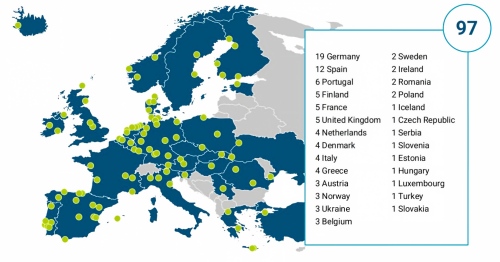
Based on the latest data from the official H2V platform as of April 2026, the platform has registered a cumulative total of 106 hydrogen valley projects. In terms of geographic distribution, European projects dominate with a 91% share, totaling 83 projects covering 21 countries across the EU and the broader European region, while the remaining projects are distributed across Asia-Pacific, the Americas, the Middle East, and Africa. Cross-border interconnected hydrogen valleys are becoming a core development trend in 2026. In terms of construction progress, the share of operational hydrogen valleys globally has doubled from 9% in 2024 to 18%, with 37% of projects completed or having entered the FID stage. Regarding long-term capacity and investment reserves, 81 projects plan to achieve commercial production by 2032, with all projects combined planning a total electrolyzer installed capacity exceeding 21 GW and overall planned capital expenditure reaching the scale of hundreds of billions of euros. In terms of application scenarios, 83% of projects target the transportation sector, while 67% focus on industrial decarbonization.
Based on a dedicated survey of global hydrogen valley developers conducted in April 2026, the report identifies three core pain points in the current industry development. First, project delays have become the norm, with 39% of projects experiencing schedule slippage, primarily due to unviable business models (39%), supply chain shortages (30%), and funding gaps (25%). Second, off-take challenges constrain FID implementation, with 68% of projects currently securing less than 25% of their target scale in firm off-take commitments. Third, industry confidence has diverged; although 59% of practitioners remain optimistic about the long-term value of hydrogen, issues such as short-term commercialization barriers, policy volatility, and funding pressures still urgently need to be addressed.
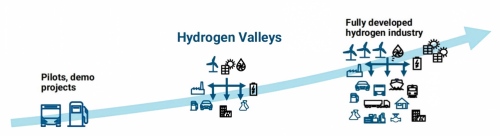
The report also outlines breakthrough pathways for developers, policymakers, and investors respectively. Developers should target core industrial users with rigid demand, build stable revenue models, continuously reduce costs through technological optimization to narrow the gap with customers’ price expectations, align with bankability standards from the early stages of project development, and leverage whole-chain synergies to unleash cluster effects, thereby breaking free from the profitability dilemma of standalone projects. Policymakers need to implement enforceable mandatory hydrogen off-take policies to activate real market demand, improve hydrogen storage, transportation, and trading infrastructure, and increase subsidies for early-stage high-risk projects to help the industry cross the “valley of death.” Investors should leverage the “multiplier effect” of public capital to bear early-stage risks and mobilize social capital, guide private capital to establish independent hydrogen asset investment systems, and encourage equity capital to position across the entire value chain, building a comprehensive risk mitigation mechanism from green power sources to end-use hydrogen.
In 2026, the EU’s Clean Hydrogen Partnership will launch the second round of project funding applications, intending to support up to 13 hydrogen valley projects, with applications officially opening in September. In terms of long-term goals, the initiative aims to establish 100 hydrogen valleys globally by 2030, building an interconnected global hydrogen industry system.



 IPv6 network supported